
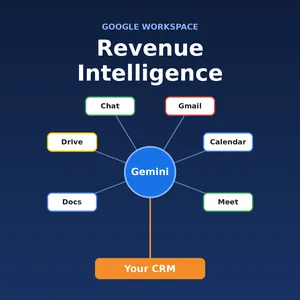
Every day, sales reps feed revenue intelligence data into Google Workspace without trying. Their interactions with prospects and customers leave a trail across Gmail, Calendar, Meet, Docs, Drive, and Chat.
Many of these same organizations also run one of two hugely popular CRM systems: Salesforce or HubSpot.
Despite their power, salespeople are short on time, so critical deal context often never makes it into the CRM. The result is blind spots, delayed or lost deals, and surprise customer churn.
To solve this, purpose-built Revenue Intelligence (RI) platforms such as Gong, Salesloft, Axiss AI, and Ergo have emerged to capture buyer signals and automate CRM updates.
But you don’t necessarily need to add another platform to your tech stack to start harvesting these insights.
If your organization runs on Google Workspace, you already have direct access to a wide range of unstructured revenue intelligence data.
With Gemini Deep Research and new CRM integrations, Workspace has evolved from a suite of productivity apps into a multi-faceted source of revenue intelligence.
Here’s how each part of Google Workspace can help you better understand, advance, and close sales opportunities.
1. Gmail: Turn Past Emails into Structured Deal Data
Email is a primary channel for B2B buyer communication. Yet much of the deal-influencing data in Gmail never makes it into the CRM: competitor mentions, shifting project timelines, new prospect contacts added to threads, pricing objections, and security requirements.
Instead of asking reps to log every detail manually, you can use AI to analyze email threads with prospects and customers and extract structured data.
By running AI analysis over Gmail conversations, revenue teams can flag “quiet” deals, detect shifts in sentiment, and populate sales methodology fields (such as MEDDPICC) with far less manual effort from reps.
2. Google Calendar: A Buyer Engagement Gauge
Calendar metadata is a strong indicator of deal velocity and relationship health. Who is attending the meetings? Has the prospect started inviting their executive leadership, or are you still stuck talking to a lower-level manager?
3. Google Meet: Summaries as Buyer Signals
Sales conversations move fast, and reps can’t listen actively while transcribing every detail. Google Meet’s transcripts and Gemini-generated notes (“Take notes for me”) turn virtual meetings into a rich layer of conversational intelligence.
These notes do more than record what was said. They act as buyer signals. Did the prospect’s IT director raise a specific security compliance question? Did the champion mention a budget freeze? By treating Meet transcripts and notes as data inputs, teams can spot hidden process bottlenecks and deal risks that a rep might have forgotten to log in the system of record.
Dedicated RI platforms work with Meet, too. Gong, for example, integrates with Google Meet to record customer calls, then analyze those conversations to surface deal risks and support rep coaching.
4. Gemini for Deep Research
Revenue intelligence isn’t just about analyzing what prospects have said to you. It’s about understanding their business well enough to anticipate their needs.
Gemini can act as an engine for cross-referencing your internal interactions with external market information.
By prompting Gemini to research a prospect’s organization, sellers can align their solutions with the buyer’s broader business environment. (We cover this in detail in How to Use Google Gemini Deep Research to Increase Sales.)
5. Gemini for Interacting With CRM Data
A revenue intelligence strategy is only as strong as its connection to the system of record. Historically, reps had to constantly toggle between Google Workspace and their CRM to check deal stages or update forecasts.
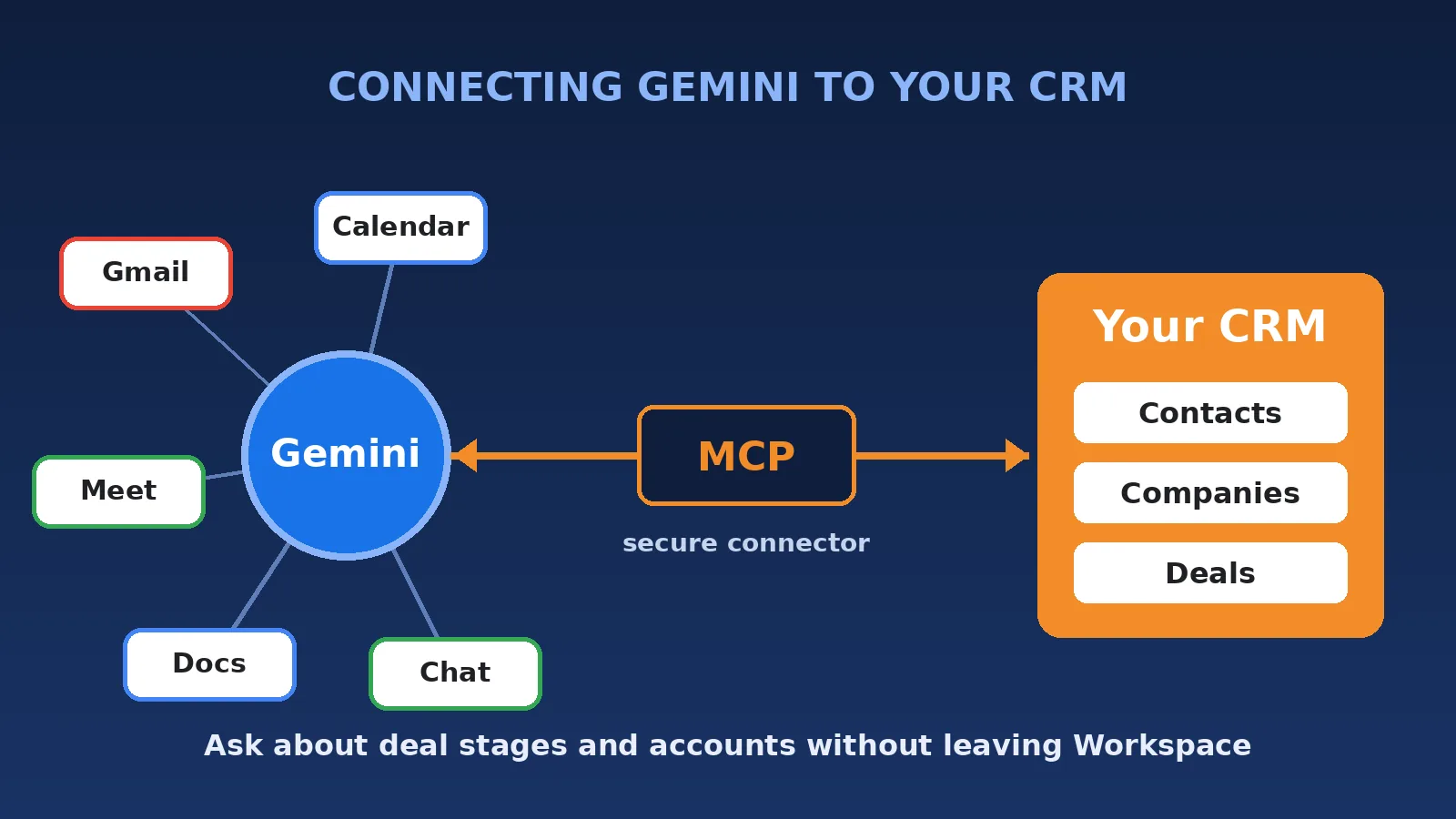
That’s changing. Google now offers Model Context Protocol (MCP) integrations that let Gemini in Workspace connect directly to HubSpot and Salesforce, among other tools. Admins control which connectors are enabled. Capabilities vary by connector: HubSpot’s connector is currently read-only for contacts, companies, and deals, while Salesforce’s integration can take actions such as creating leads, contacts, and cases (currently through an early access program or Gemini Alpha).
6. Gemini for Generating Daily Briefs for Sales Reps and Managers
Imagine a sales rep starting the day not by staring at a static CRM dashboard, but by reading an AI-generated daily brief.
By looking across Google Workspace, AI can produce a proactive morning briefing like this: “You have three deals slipping because the champions haven’t replied to your emails in nine days. Your meeting with Acme Corp is today at 2 p.m. Based on your last Google Meet transcript, you need to address their integration concerns. Here are draft emails ready to send.” That turns administrative oversight into guided, strategic action.
7. Google Chat for Internal Intelligence
Internal deal swarming happens in Chat. By reviewing the questions reps ask solutions engineers and product teams in Chat spaces, revenue leaders can identify which product limitations or competitor comparisons repeatedly stall deals.
Gemini as a “Lite” Revenue Intelligence Platform
If all these signals live in Workspace, here’s the question: Can Gemini connect the dots and act like a standalone revenue intelligence platform?
The short answer: “Yes, with some assembly required.”
Gemini in Google Workspace serves as the connective tissue across your digital office. Because it can work with your Gmail, Calendar, Docs, Drive files, and Meet notes and transcripts, while respecting the access you already have, it acts as a central reasoning engine.
Pair Gemini with its HubSpot or Salesforce integration to cross-reference your system of record with unstructured communication data.
You can prompt Gemini with something like:
Review my last three emails with [Company] and their current @HubSpot deal stage, and tell me whether we’re at risk of missing the close date.
Purpose-built RI platforms still have advantages: out-of-the-box dashboards, proprietary deal-scoring algorithms, and consistent, structured data capture without custom setup.
However, for organizations that want more value from the tools their teams already use every day, Gemini offers a flexible, conversational approach to revenue intelligence that turns hunches into data-backed decisions.
Gemini in Google Workspace
- Works across the tools your team already uses every day
- Cross-references HubSpot or Salesforce through its integrations
- Flexible, conversational approach
- Some assembly required
Dedicated RI platform (e.g., Gong)
- Out-of-the-box dashboards
- Proprietary deal-scoring algorithms
- Consistent, structured data capture without custom setup
- Another platform to add to your tech stack